
Economic Review: Mar25 – Feb26
A year shaped by shifting interest rates, geopolitical shocks, and diverging market performance
Global Economic Overview
The 2025/26 financial year was defined by three major macro themes
Disinflation → Policy Easing (Early Phase)
Global inflation moderated through much of 2025.
Central banks (including South Africa) began cutting or pausing interest rates.
This supported:
Equity market strength (especially early in the period)
Improved investor sentiment
In South Africa, inflation eased to around ~3–3.6%, allowing rate cuts of ~125bps
Growth Remained Fragile
Global GDP stayed uneven and below trend
South Africa GDP:
Growth ~1%–1.4%
Improvements driven by:
Better electricity supply
Lower inflation
Improved investor sentiment (FATF removal, ratings upgrade)
Geopolitical Shock (Late Phase – 2026)
Middle East conflict (Iran / Strait of Hormuz)
Oil prices surged above $100/bbl
Global inflation risks re-emerged
Markets turned volatile
This created a “second inflation scare”, delaying expected rate cuts globally
South African Economic Themes
Inflation Stability & Policy Credibility
Inflation anchored around ~3%–4%
SARB shifted toward a 3% target
Strengthened policy credibility and investor confidence
Interest Rate Cycle Turning
Rate cuts were supported by consumer relief and asset price stability in 2025
Start of 2026, cuts paused due to global risks
Rand Resilience (with Volatility)
Supported by improved fundamentals and strong commodity exports (Gold)
Pressured by global risk-off periods and USD strength during geopolitical stress
Asset Class & Market Insights
US Markets (S&P 500, Nasdaq, Dow Jones)
Boom → Correction → Volatility
Early period:
Continued momentum from tech/AI optimism
Mid-to-late period:
AI bubble concerns + tariffs triggered sell-off
Significant correction in US equities
Y/Y Growth
S&P 500 +15.52%
Nasdaq +20.27%
Dow Jones +11.72%
US markets showed how quickly sentiment can shift from “growth optimism” to “valuation concern”.
JSE ALSI
Relative resilience
Y/Y Growth +49.47%
Supported by:
Commodity exposure
Stronger Rand (periods)
Improved SA sentiment
SA equities benefited from global diversification and commodity strength, outperforming expectations in a low-growth environment.
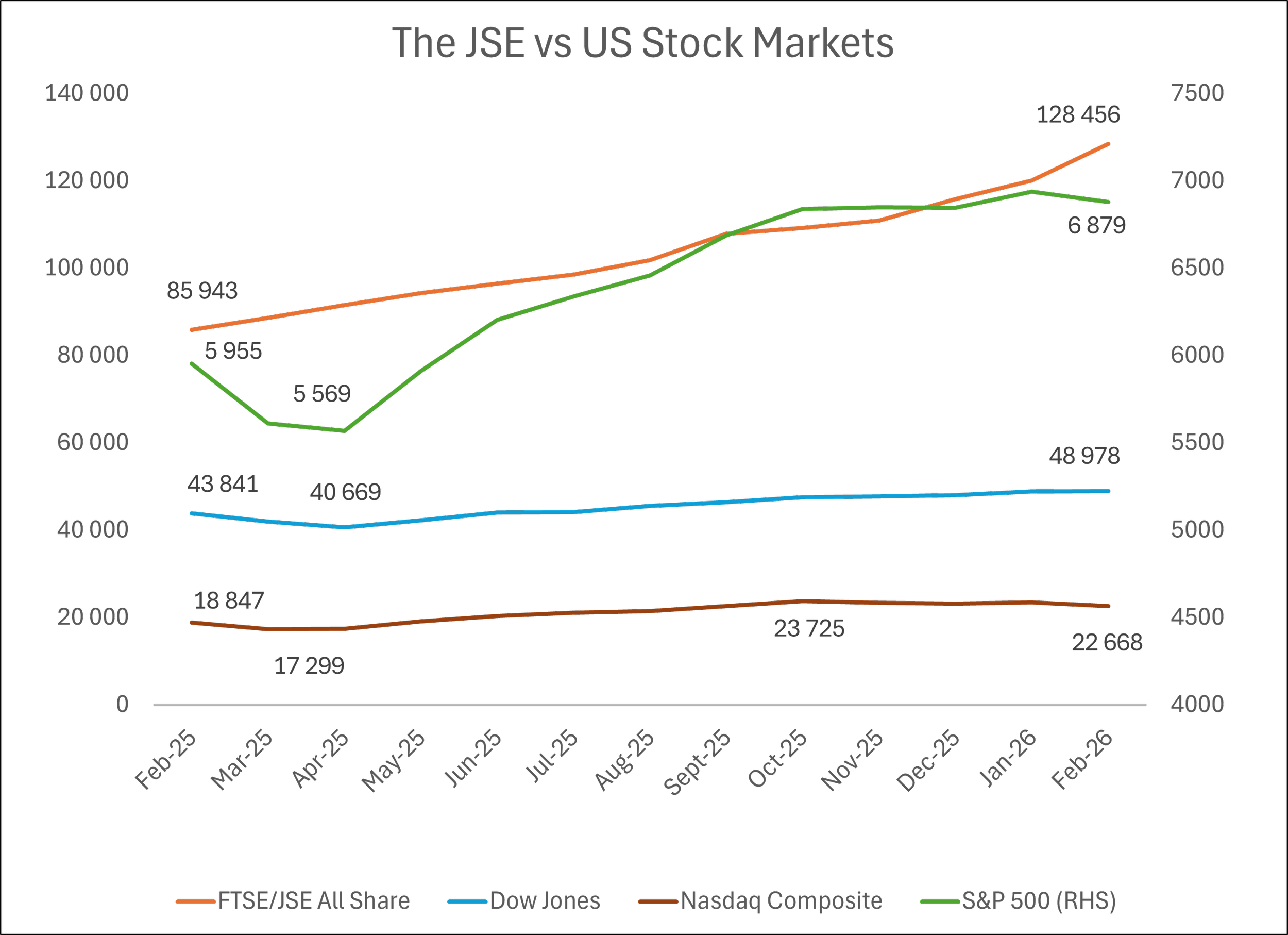
The JSE, the Dow Jones and S&P 500 hit their peaks in either January or February 2026, but the Nasdaq Composite hit its high in October 2025
Currency (USD/ZAR)
Volatility within a strengthening trend
Biggest drivers:
Stronger SA fundamentals (positive)
Global risk-off (negative)
USD strength during crises (negative)
The Rand remained a high-beta currency — strengthening in calm markets, weakening during global shocks.
Bitcoin
Institutional adoption vs macro sensitivity
Supported by:
Continued institutional interest
Alternative asset narrative
Pressured by:
Risk-off environments
Liquidity tightening
Bitcoin increasingly trades like a risk asset (tech proxy) rather than a pure hedge (like gold)
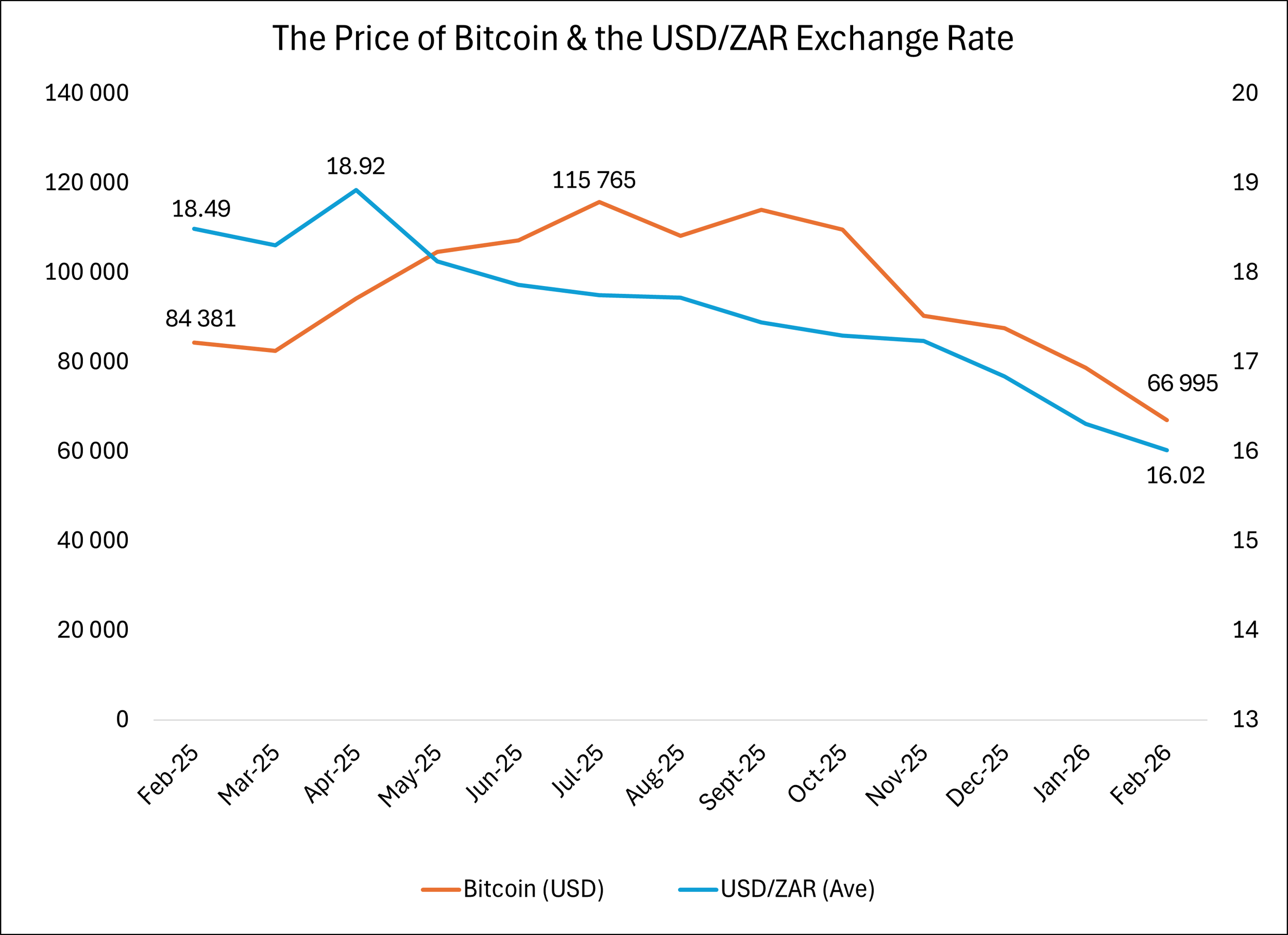
Up until February 2026, the rand went from strength to strength, but bitcoin lost momentum after September 2025
Commodities
Gold (USD/oz)
Safe haven demand
Rose during geopolitical tensions and inflation uncertainty
Gold reaffirmed its role as a portfolio hedge during uncertainty
Silver (USD/oz)
Hybrid metal
Followed gold (safe haven) and is also tied to industrial demand
More volatile than gold due to dual role (industrial + monetary)
Platinum Group Metals (PGMs)
Structural pressure with cyclical support
Weakness due to EV transition reducing catalytic converter demand
Support from supply constraints and SA production dynamics
PGMs remain a structurally challenged but cyclical opportunity asset
Brent Crude Oil
Shock-driven spike
Stable in 2025 but saw a sharp spike in 2026 due to Strait of Hormuz disruption and war risk
Oil briefly surged above $110/bbl in March 2026
Energy remains the single biggest macro shock variable in global markets
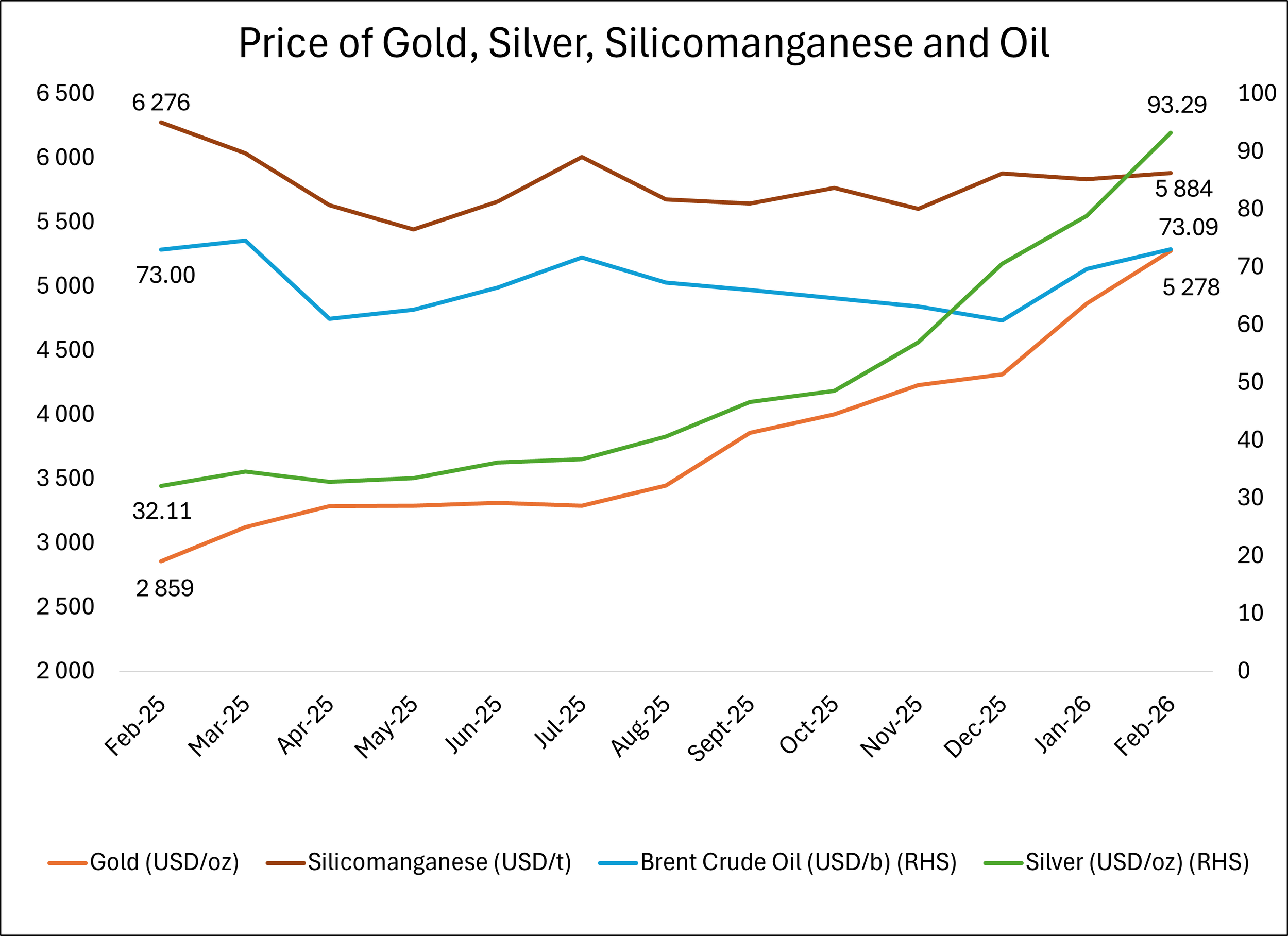
Of the commodities shown, gold and silver ended February 2026 at record monthly closes, oil had a nice recovery and silicomanganese down by more than 5% Y/Y in February 2026
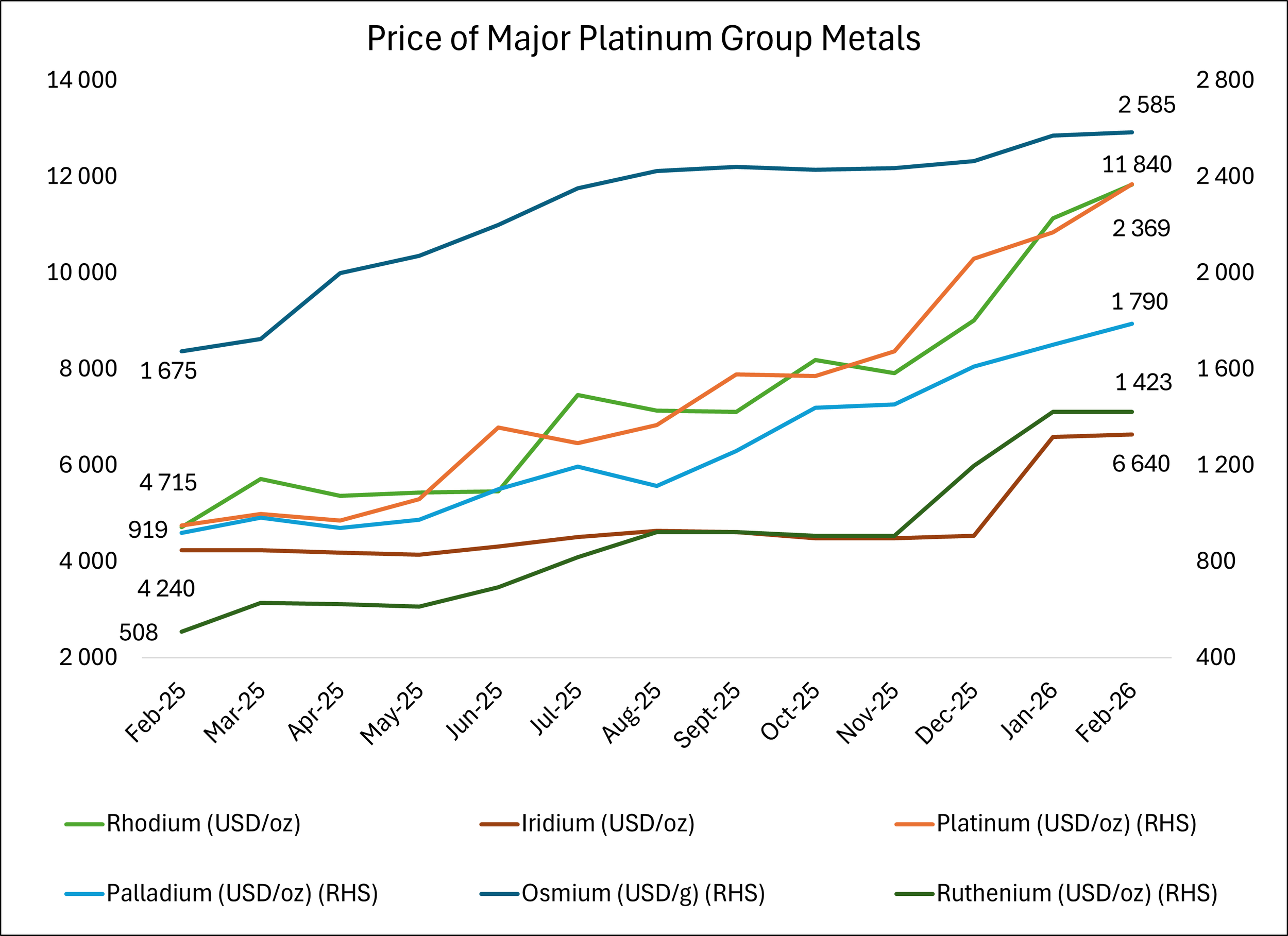
All the major Platinum Group Metals (PGMs) were up by over 50% Y/Y in February 2026, with rhodium the best performer and osmium the weakest
Conclusion
The 2025/26 financial year highlighted a clear shift back to macro-driven markets, where movements were influenced more by interest rates, inflation expectations, and geopolitical developments than by company fundamentals alone.
This environment reinforced the value of diversification, as different asset classes—such as commodities and South African equities—responded differently to global events, helping to manage risk and enhance returns. Market direction was largely dictated by changing policy expectations, with optimism around potential rate cuts driving gains, while uncertainty led to corrections. At the same time, geopolitics re-emerged as a key force, with war, trade tensions, and tariffs directly impacting inflation, oil prices, and currency movements.
For investors, the key takeaway is that markets are now shaped by multiple, interconnected forces—including interest rate cycles, inflation dynamics, geopolitical risks, and long-term structural shifts—making a diversified, actively managed investment approach more important than ever.
Written and compiled by Jason Mattes and Runes le Roux
Sources & References
Nedgroup Investments. (2026). Budget 2026: Encouraging signals for long-term financial planning. Available at: ttps://www.nedgroupinvestments.com/content/NGISingleSiteContent/Local/Individual-Investor/learn-more/news
Moonstone Information Refinery. (2026). Budget strengthens saving for retirement, says Sanlam. Available at: https://www.moonstone.co.za/upmedia/uploads/library
Allan Gray. (2026). 2026 Budget: A good news story. https://www.allangray.co.za/latest-insights
South African Reserve Bank (2025). Monetary Policy and Interest Rate Decisions. Available at: https://www.resbank.co.za
International Monetary Fund (2026). South Africa Economic Outlook and Policy Recommendations. Available at: https://www.imf.org
Deloitte (2025). Africa Economic Outlook. Available at: https://www.deloitte.com
Trading Economics (2025–2026). South Africa Interest Rate & Inflation Data. Available at: https://tradingeconomics.com
Associated Press (2026). Global Oil Market and Geopolitical Developments. Available at: https://apnews.com