
Budget 2026
South Africa’s 2026 National Budget — What It Means for You
On 25 February 2026, South Africa’s Minister of Finance, Enoch Godongwana, delivered the annual National Budget Speech outlining the government’s financial priorities for the 2026/2027 fiscal year.
Widely praised as a “budget for saving and investing,” it focuses on stabilising public finances, supporting households, encouraging savings, and investing in growth-enhancing infrastructure. Notably, the Minister introduced positive measures relating to retirement funds, tax-free savings accounts, and discretionary allowances for offshore investing, while also potentially putting more money back into the pockets of savers by adjusting tax brackets for inflation after several years of no changes and retaining medical aid tax credits.
We’ve broken down the key points in simple language so you can understand what it means for you, your family and your money.
The Big Picture: Growth & Fiscal Discipline
The Budget aims to:
Shrink the budget deficit — the gap between what government earns and spends — from around -4.5% to -4.0% of GDP in 2026/27 and further over the medium term.
Keep a primary surplus (when revenue exceeds spending before interest costs) to show fiscal discipline.
Project modest economic growth — around 1.6% in 2026, rising to about 2% by 2028.
Why this matters: A smaller deficit and disciplined spending help reduce pressure on interest rates and debt, making the economy more resilient over time.
Tax Changes: Relief Where It Counts
No Broad-based Tax Hikes
Thanks to stronger-than-expected revenue performance, the government withdrew previously proposed tax increases totalling R20 billion, meaning no major tax hikes for most taxpayers this year.
Tax Relief for Households
To help cope with inflation and cost pressures:
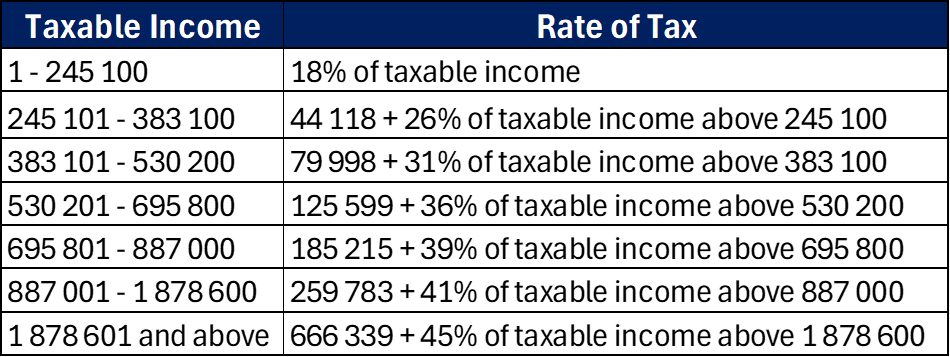
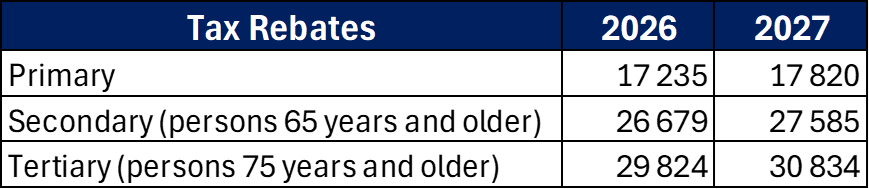
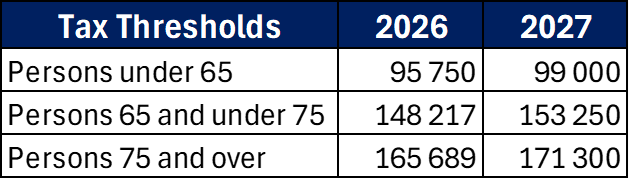
Personal income tax brackets and rebates are fully adjusted in line with inflation — protecting your take-home pay (below are the latest tables).
The Tax-Free Savings Account (TFSA) annual limit rises from R36 000 to R46 000, giving you more room to grow savings tax-free. Overall contribution remains at R500 000
The retirement fund deduction cap increases from R350 000 to R430 000, encouraging long-term retirement saving. Deduction remains at 27.5% of taxable income.
Medical tax credits will increase from R364 to R376 for the first two members, and from R246 to R254 for additional members.
Capital gains tax annual exclusion increases to R50 000 (from R40 000)
Capital gains tax exclusion at death increases to R440 000 (from R300 000)
Capital gains tax on primary residence sales exclusion increases to R3 000 000 (from R2 000 000)
Increase in donations tax exemptions to R150 000 for natural persons (from R100 000)
Interest exemption remains unchanged -
R23 800 for below 65
R34 500 for above 65
De minimus rule -
Retirement interest for commutation – increase from R247 500 to R360 000 - the equivalent annuity portion increases from R165 000 to R240 000
Living annuity commutation – increase from R125 000 to R150 000
These rules do not apply to guaranteed life annuities
Offshore discretionary allowance increases for individuals to R2 million per calendar year.
What this means for you: These changes help protect your income and give you more capacity to save and invest.
Tax Rates for Individuals
VAT, Fuel Levies & “Sin” Taxes
While broad-based taxes haven’t increased, some levies have been adjusted for inflation:
The general fuel levy rise slightly (+9c/litre on diesel and +7c/litre on petrol)
Road Accident Fund Levy on both petrol and diesel was upped by 7c/litre
Carbon Tax on Fuel was hiked by 5c/litre for petrol and 6c/litre for diesel
Excise duties on alcohol and tobacco increase modestly (+3.4%)
VAT remains at 15%
Why it matters: These increases are relatively small but can affect daily expenses (especially fuel).
Social Support: Grants & Welfare
Social protection remains a key focus:
Social grants will see inflation-linked increases in April and October 2026, helping millions of recipients.
The Social Relief of Distress grant continues in its current form for the year ahead.
From April 2026, social grants will increase as follows:
The old-age, disability and care-dependency grants will rise by R80 to R2 400 per month.
The war veterans grant will also increase by R80 to R2 420 per month.
The foster-care grant will increase by R40 to R1 290 in April, with a further R10 adjustment in October, bringing it to R1 300 per month.
In addition, the child support grant and grant-in-aid will increase by R20 to R580 per month.
Why this matters: These increases help low-income households keep up with rising living costs.
Where Government Is Spending Your Money
Total government spending in 2026/27 is about R2.67 trillion. Here’s how the major areas stack up:
Education: receives the largest share — including funds for early childhood and school nutrition programmes.
Health: ongoing funding for HIV/AIDS programmes and doctor compensation shortfalls.
Peace & Security: increased funding for police, defence and border management.
Infrastructure & Jobs: transport, water, and energy projects aimed at creating jobs and growth.
Focus on basics: Over 60% of non-interest spending goes to social programmes like education, healthcare and social protection.
Reforms & Long-Term Strategy
The Budget outlines a principles-led fiscal anchor — a new legal approach to guide spending and enhance credibility over time.
Government also continues to push structural reforms in areas like:
Energy market participation
Transport logistics
Training and skills development for young people entering the workforce
These reforms aim to encourage investment and improve long-term growth.
What This Means for You
✅ Your tax burden won’t increase broadly this year.
✅ You get more tax-free room to save and invest.
✅ Social grants rise to help vulnerable households.
❗ Some levies like fuel and alcohol/tobacco duty go up slightly.
📈 Government is prioritising education, infrastructure, and fiscal stability.
This Budget tries to balance support for citizens with responsible financial management — without adding major tax pain in tough times for households and businesses.
Written and compiled by Jason Mattes and Runes le Roux
Sources
Stanlib, Moneyweb, South African Government – Official 2026 Budget Speech, NovaNews, Reuters & news analysts summaries.
https://www.moonstone.co.za/budget-strengthens-saving-for-retirement-says-sanlam
https://www.allangray.co.za/latest-insights/personal-investing/2026-budget-a-good-news-story